Posts

Showing posts with the label data

A Chinese Room with a View

Image
These days the name of Alan Turing is associated as much with computers as the name Isaac Newton is with gravity. Quite rightly so. Whilst his work on cryptanalysis at Bletchley Park during World War Two might cause some to consider him a shadowy figure in the world of twentieth century espionage, I would like to think that in the long historical view it will be a thought experiment of his that will be remembered most of all - the Turing Test . In its simplest form the test states that if an interrogator having a conversation over a keyboard (online chat, basically) with a second party cannot distinguish between a real person and a computer program, then the computer (program) could be said to be thinking. Even though this once thought experiment has now been carried out in reality, (most notably at the Loebner Prize which has been carried out annually since 1991) no-one yet wants to stick their neck out and claim that a machine has definitely passed and ipso facto can think. ...

Data Storage Solutions

Image
Readers of my recent blog entry about how reality is in all probability a computer simulation are quite right to feel sceptical. It's clearly a ridiculous notion, a clever bit of philosophical reasoning designed to invoke a paradox. Instinctively we know this. The Simulation Hypothesis goes against what we feel is the truth and as William of Occam himself carved with his famous Razor, the simplest explanation is usually the correct one. The original words of Occam's Razor are in fact particularly astute in this case; pluralitas non est ponenda sine necessitate or in plain English, plurality should not be posited without necessity . Why hypothesize a multitude of simulations when one simple reality will do? It's just common sense. However, common sense isn't always right. The ancients believed that the Earth was flat - and you can see why. It feels like common sense. Down is down - it's where things fall to. The ground is clearly flat and the sky "u...

Aping reality

Image
Nothing is real. No, that's not strictly true. To put it another way, everything is real. If it wasn't real it wouldn't be . The point I'm trying to make is that this world may very well not be the real one. Whatever that means. I'll start again. There is a theory that states that if it ever became possible to simulate reality in a computer, such a simulation would be indistinguishable from the real thing and any inhabitants of the simulation would be completely unaware that they were all simply part of a gigantic computer program. There is another theory that states that this has already happened. It's known as the Simulation Hypothesis and has been put forward by Nick Bostrom who is either a philosopher at the University of Oxford or (if his hypothesis is to be believed) a simulation of a philosopher at a simulation of the University of Oxford. The premise is very simple. If, hypothesises Bostrom, it ever becomes possible to simulate reality i...

Seeing Red

Image
There is an old philosophical chestnut about seeing the colour red. How do we know that what I see as red is what you see as red? We may both call it red, and may be referring to the colour of tomatoes, blood and pillar boxes, but how do I know that what you call red isn't what I call green? This is a simplified version of John Locke's Inverted Spectrum (I'm talking about the philosopher rather than the erstwhile passenger of Oceanic 815), a thought experiment in which we wake up one morning and find that all the colours in our sensorium have inexplicably reversed. Aside from providing the inspiration for a potentially interesting blues number (" Woke up this mornin'... Everythin' red had gone green / Yeah I woke up this mornin'... Everythin' green had gone red / Had green strawberry jam on toast for breakfast... Think someone's messing with my head... ") there's no real reason why this should occur other than to introduce the rea...

Fiddler on the Loose

Image
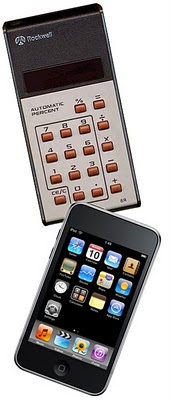
All that talk of the Rockwell 8R that I indulged in last time reminded me of something I discovered way back then but never really shared with anyone until now. The next model of calculator up from mine was the Rockwell 18R which was a very similar device except that it had the benefit of a memory . Imagine that. Only the rich kids in school had calculators with memories . You'd have thought that what with my four function calculator being my proudest possession (aside from my clunky LED digital watch) I'd have treated it with kid gloves, but far from it. I was always obsessed with taking things to pieces. I'm not sure why - it's not as if prying the back of most machinery would have given me any insight into how it worked, but I used to do it anyway. Once I was convinced that if I swapped the connections for the aerial and the loudspeaker on an old valve radio I'd have built myself a radio transmitter. Anyway, I pulled the front off my calculator and was surpri...

Sufficiently Advanced Technology...

Image
"Any sufficiently advanced technology is indistinguishable from magic." Arthur C Clarke My old iPod broke down irretrievably the other day. Well, I say irretrievably, but I'm sure someone out there knows how to replace the hard drive for a tidy sum, but in the meantime it's quicker and easier (and probably not that more expensive) for me to buy a new one. After all I've had it nearly five years - that's an eternity for a modern gadget. It was good to finally have a proper reason to visit the new Apple store in Churchill Square. It had been sitting there between River Island and the Build A Bear Workshop for a few months now, a tempting technological candy store for the kid in me. And now I was finally going shopping there. I decide to go for the middle of the range iPod Touch. With a capacity just over that of my previous iPod, I decided that it probably had what it takes for all my music and podcast listening needs. What I didn't realise was how many o...

Big Numbers

Image
Every word I type I am adding to the sheer volume of information created by the human race and increasing the complexity of the universe. If you look up the amount of information created and stored over the last few years it's becoming ridiculous. In 2008 a total of 3,892,179,868,480,350,000,000 new bits were created. That's brand new bits, never mind all the rest of recorded history up until 2007. Let's get that into some kind of perspective and convert into bytes. Eight bits to a byte, that gives us 486,522,484,000 gigabytes, which is still generally the largest storage unit people are currently comfortable with - although I have a one terabyte hard disk sitting under my desk. It's still difficult to get this into perspective though. A gigabyte is approximately 1000 times the capacity of an old fashioned floppy disk, remember them? A floppy disk was approximately two millimetres thick. So, a gigabyte is approximately a two metre high stack of floppies. A terabyte th...